|
By: Michael Manion |
|
|
Page Views: 7,955 |
| Hashtags: #BoneCancer #Cancer #Health |
| All about bone cancer. |
| Estimated reading time: 2 minute(s) (325 words) |
Cancer that arises in the bone (primary bone cancer) is not the same disease
as cancer that spreads to the bone from another part of the body
(secondary bone cancer). Primary bone cancer is rare, with only about 2,500 new
cases diagnosed each year in the United States. More commonly, bones can be the
site of tumors that result from the spread (metastasis) of cancer from another
organ, such as the breasts, lungs, or prostate.
The most common type of bone cancer is osteosarcoma, which develops in new
tissue in growing bones. Another type of cancer, chondrosarcoma, arises in
cartilage. Evidence suggests that Ewing's sarcoma, which is another form of bone
cancer, begins in immature nerve tissue in bone marrow. Osteosarcoma and Ewing's
sarcoma tend to occur more frequently in children and adolescents, while
chondrosarcoma occurs more often in adults.
| Types of Cancer |
Tissue of Origin |
Common Locations |
Common Ages |
| Osteosarcoma |
Osteoid |
Knees, upper legs, upper arms |
10-25 |
| Chondrosarcoma |
Cartilage |
Pelvis, upper legs, shoulders |
50-60 |
| Ewing's Sarcoma |
Immature nerve tissue, usually in bone marrow |
Pelvis, upper legs, ribs, arms |
10-20 |
Bone cancers occur more frequently in children and young adults, particularly
those who have had radiation or chemotherapy treatments for other conditions.
Adults with Paget's disease, a noncancerous condition characterized by abnormal
development of new bone cells, may be at increased risk for osteosarcoma. A
small number of bone cancers are due to heredity. For example, children with
hereditary retinoblastoma (an uncommon cancer of the eye) are at a higher risk
of developing osteosarcoma.
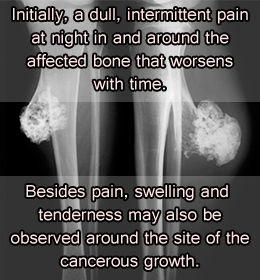
Pain is the most common symptom of bone cancer. However, symptoms may vary
depending on the location and size of the tumors. Tumors that occur in or near
joints may cause swelling or tenderness in those areas. Bone cancer can also
interfere with normal movements and can weaken the bones, occasionally leading
to a fracture or fractures. Other symptoms may include fatigue, fever, weight
loss, and anemia.